
Fastaval would not exist if it weren’t for the many organisers who, year after year, volunteer their time and energy to create the best possible convention.
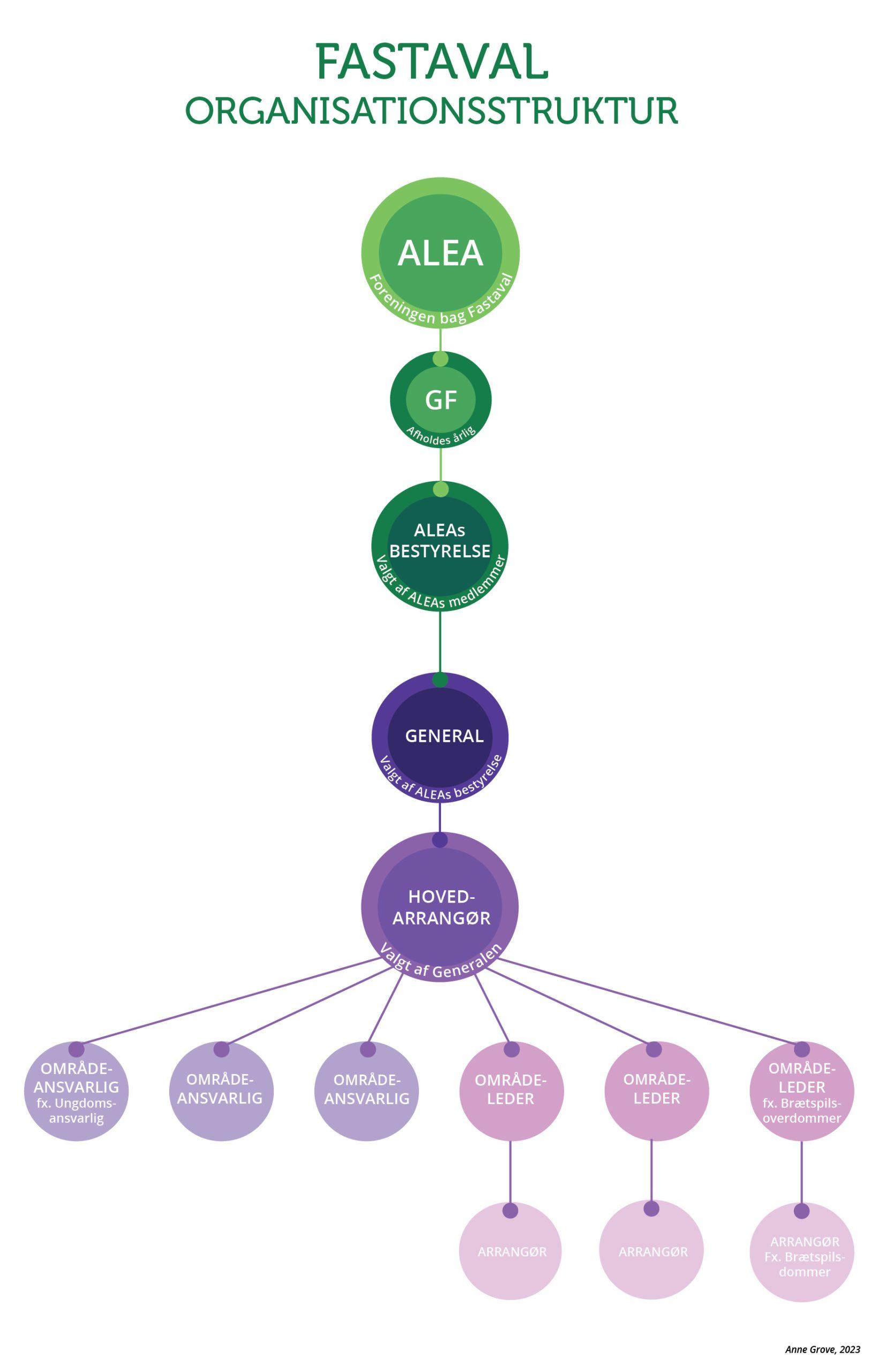
Below is an overview of Fastaval’s organizational structure.

ALEA
Fastaval is organized by the association ALEA, which works closely with the main organizers and the different organizing areas every year.
Read more about ALEA here.
Organizer areas
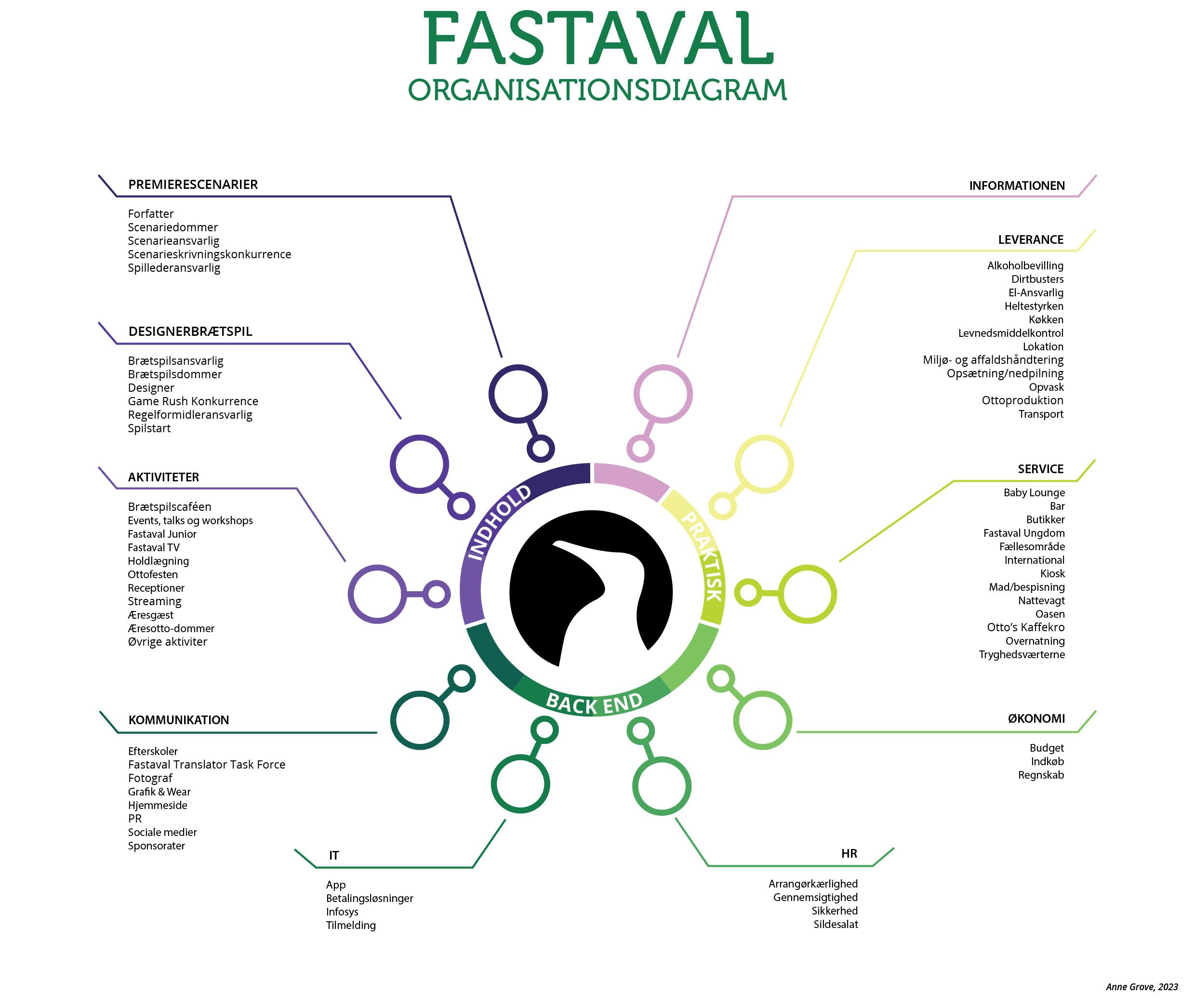
Fastaval works like a big machine, consisting of many different organizer areas. Each area has one or more main organizers with a number of organizers under them. Below you can get an insight into the many areas that work together to create Fastaval.
Want to join us?
Without organizers and volunteers, there is no Fastaval. If you want to get involved, we’d love to hear from you.
- Do you have an idea where you can contribute to Fastaval in the existing org chart?
- Do you have an idea for something new and exciting that Fastaval should include next year?
- Do you just want to help, but don’t know how?
Either way, send us an email at fastaval@fastaval.dk! We’ll talk about how you can help, what you want and how it fits into Fastaval.
The main organisers
Fastaval’s main organizers are the backbone of each Fastaval.
They act as coordinators for all of Fastaval’s other organizing areas and make practical decisions about pricing and locations, but they must also be visionaries on behalf of the convention.
The group is led by the General, who appoints the other members. The General himself is appointed by Alea’s Board of Directors, who in turn are appointed by a General Assembly. Typically, the main organizers are put together just before or after Fastaval and work from there to create the next Fastaval. The General is often announced at Fastaval the year before they are to serve as General.
Want to know who’s in this year’s main organizer group? Find out more on their page here.
The organisation Alea
ALEA is the association behind Fastaval, and its goal is to organize the best Fastaval possible. Many people don’t know it, but ALEA plays a huge role in organizing and running Fastaval year after year. While the main organizers concentrate on the individual Fastaval, it is ALEA that has the long-term plans and is constantly working to future-proof the festival.
What you might not know about ALEA?
- It is ALEA’s responsibility to organize Fastaval
- ALEA sets the financial framework for Fastaval every year
- It is ALEA that annually appoints the next general
- ALEA is responsible for managing Fastaval’s warehouse and all the practical work around it
- ALEA organizes Fastablues after every Fastaval
Every year a general meeting is held, which includes the election of ALEA’s board of directors. You can read more about ALEA and who is on the board here.
Why join ALEA?
When you register for Fastaval, you also have the option to join ALEA. If you do, you get a discount on your Fastaval ticket, but in addition to the discount, you also support Fastaval and ALEA’s work going forward. The more members ALEA has, the more impact the association has in its collaboration with municipalities and other external actors. If you become a member of ALEA, you will contribute to a better Fastaval in the long run.
ALEA and Bifrost National Association
ALEA is a member of the national association Bifrost. This also means that the more members ALEA has, the more members Bifrost has.
The national association Bifrost brings together role-playing associations from across the country to create cohesion and a united front within interactive and creative forms of expression such as role-playing. Bifrost provides a great deal of assistance to its member associations in the form of, among other things, help navigating municipal regulations, help with financial management, and equipment loans. But Bifrost’s most important function is probably to allocate resources to lobbying so that our hobby becomes even more visible.
In addition, Bifrost distributes thousands of grants every year through the Bifrost Pool to member associations such as ALEA.
You can read more about the National Association Bifrost here.
How do I sign up?
You can join ALEA through the Fastaval registration. It costs DKK 75 per year. ALEA members get a discount on the entrance ticket to Fastaval.
If you would like to join ALEA without registering for Fastaval, please send an email to ALEA at alea@fastaval.dk.
Information about the association Alea:
CVR number 32693946
Address
Ribesvej 3
9500 Hobro
The very first Fastaval
Sometimes things don’t start. They just happen. And afterwards, it’s easy to look back on them and say: That’s where it began. That’s how the first Fastaval came about a long time ago. Not as a vision that sprang fully formed from someone’s mind. But as an almost random chain of events that arose from a deep and naive love of games. The year was 1986. The mood was not the best. In January, the American space shuttle Challenger exploded – the biggest disaster ever for the US space programme. In February, Sweden’s Prime Minister, Olof Palme, was shot dead in Stockholm – the closest Scandinavia has come to the Kennedy assassination. And in March, around 150 gaming enthusiasts gathered for a gaming weekend in Aarhus.
The Fasta club created Fastaval
And how did it all begin? In the early 1980s, role-playing games were something few people in Denmark had heard of. A few had tried playing them while staying in the United States or the United Kingdom. Others had picked up a rulebook for Dungeons & Dragons or Call of Cthulhu in obscure shops. A note posted in the Yellow Kid comic book shop in Aarhus led to a meeting at the university, where around 20 people, most of them between 16 and 22 years old, showed up.
Yes, there was a basis for a club. A founding general meeting was convened a few months later, in March 1985. Twenty-six people attended, and it was here that Mads Lunau came up with the name Fasta as an anagram of Fantasi-Strategi-Taktik (Fantasy-Strategy-Tactics). Support was hesitant: 14 of the 26 voted in favour of the name. On the other hand, he was elected chairman almost unanimously. In April 1985, the five board members, led by Mads, and two alternates – Malik Hyltoft and Adam Hannestad – met in Malik’s dorm room at Aarhus University. One of the most important items on the agenda was how to increase the number of members in the role-playing club so that the municipality would provide support for the association. Without support, there would never be enough money for club premises, for example. No one can remember exactly who came up with the idea of organising a big gaming day in May 1985. Probably Mads or Malik. At that time, most of the good ideas came from the two of them, who knew each other from high school national conferences, where they clashed as ardent left-wingers and communists, respectively, and gained unexpected respect for each other. Posters were typed, photocopied and hung up in suitable places in Aarhus – university departments, a couple of secondary schools, hobby shops and comic book stores. Creativity with names had been exhausted with “Fasta”, so the invitation was titled “Game Day”. Later, much later, it was remembered internally as Fastaval 0.
150 participants at the first Fastaval
No one can remember for sure how many people attended the first Fastaval, which was not called Fastaval at the time, but in total there were no more than 50 and probably no more than 40. The game day was to be repeated in 1986, and in January the first invitations were sent out to what was somewhat optimistically called “The 1st International Fastaval” in Aarhus on 7-9 March. The invitation was addressed “to all board gamers, role-players and other crazy people”. The process was so chaotic that at that point, no venue had even been found. Only afterwards, a few weeks before the start, did they manage to reserve Skt. Anna Gades Skole in the Frederiksbjerg district of Aarhus. Every day, the venue had to be closed and shut down at 10 p.m., so the Fasta members offered accommodation to guests, especially those from Odense and Copenhagen. The decision to cook in the kitchen of Adam Hannestad’s nearby flat was only made a few days before, because it sounded from the pre-registrations that the approximately 150 participants would be hungry. There was no theme – just a bunch of board games like Car Wars, Risk, Diplomacy, Conquistadors, and Third Reich, and some role-playing games: Marvel and the hits Call and AD&D. The people from the role-playing club in Odense provided the Call scenario – The Monastery in the Mountains – and laid the foundation for a long tradition of the two clubs collaborating on conventions and hosting guest scenarios at each other’s venues.
Emphasis on role-playing
When cleaning up after the first “real” Fastaval in 1986 with 150 participants, one thing was certain: it had to be tried again the following year. And the feedback was clearly most positive on the role-playing: it was at this convention that the foundation was laid for Aarhus – in contrast to the gaming clubs in Copenhagen and Odense – placed the main emphasis on role-playing in the form of written scenarios After its first faltering steps in the late 1980s, Fastaval quickly grew into a large and well-organised convention. In the early 1990s, however, it was difficult to entice anyone to write scenarios for Fastaval, and both threats and pressure were used to get people to write scenarios. And it was even more difficult to get people to submit the scenarios.
It was clear to the organisers that something had to be done to make writing scenarios more attractive, and in 1992 the ‘Ottoen’ award was introduced at Fastaval. The award did not go to the participants, but to the authors at Fastaval, who were honoured at the first banquet at Fastaval.
Ottoen attracted a lot of attention in the role-playing community, because it was both transgressive and provocative in a hobby that was all about no one being the best, naming winners and pointing to one scenario as the best of them all.
Otto had the desired effect, and in the years that followed, it became easier to get people to sign up to write screenplays – and if the writers wanted to participate in the competition for the coveted gold penguin, they had to submit their scripts in good time so that the judges could read them – and in this way, Otto solved both the problem of attracting scriptwriters and getting them to submit their work before the convention itself.
Today, it is not a question of enticing people to write, but of selecting from among the synopses submitted to Fastaval, and Otto was the catalyst for the entire writing culture that has made Fastaval the leading convention in the world when it comes to quality scenarios.
A congress in constant motion
Many things have changed at Fastaval since the doors opened for the first congress in 1986. Fastaval is an ever-changing congress where nothing is set in stone. Fastaval has always been what the organizers have made it, and there is a constant turnover of organizers at Fastaval, all with their own visions and ideas.
However, the starting point for around 900 people to meet at a school or high school at Easter is the same today as it was in 1986. Original role-playing games and original board games written and designed for the congress are played, and participants also play many other types of games.
It is possible to arrive at Fastaval on Wednesday and return home after Ottofesten on Monday without being exposed to the real world, if desired. Accommodation is available at Fastaval, and it is possible to register for breakfast and dinner, and food can be purchased at various locations at the convention.
When participants are not playing role-playing games, board games or other games, they enjoy themselves and socialise at the convention, where there is a cosy board game pub, a café serving cocktails and drinks, and a bar where you can enjoy a cold beer.
Fastaval has changed in many ways since the first convention in 1986, but the focus is still on being together with others who love different types of games.


